

- Written by: Michelle Myers
- 25 September 2026
- Categories: Insights
- Tags:
Findability: How Purpose-Driven Brands Become Easier to Discover, Trust,
and Choose
You're good at what you do. But can someone tell from Googling you?
A prospective client may need your expertise, share your values and live ten minutes from your practice, and still never find you. That’s the uncomfortable gap between being good at what you do and being discoverable by the people who need you.
Findability is the work of closing that gap. It means making it easy for the right people to find your business, understand what you offer and trust you enough to take the next step, whether they start on Google, in a WhatsApp group, on LinkedIn or with a friend’s recommendation.
For trust-based practitioners in South Africa, such as counsellors, coaches, financial advisers and wellness practitioners, that usually means clearer signals in the places clients already look, rather than more noise. Your business already leaves clues online. Findability makes sure they point in the same direction and tell the same honest story.
What Findability Means (and Why Visibility Alone Falls Short)
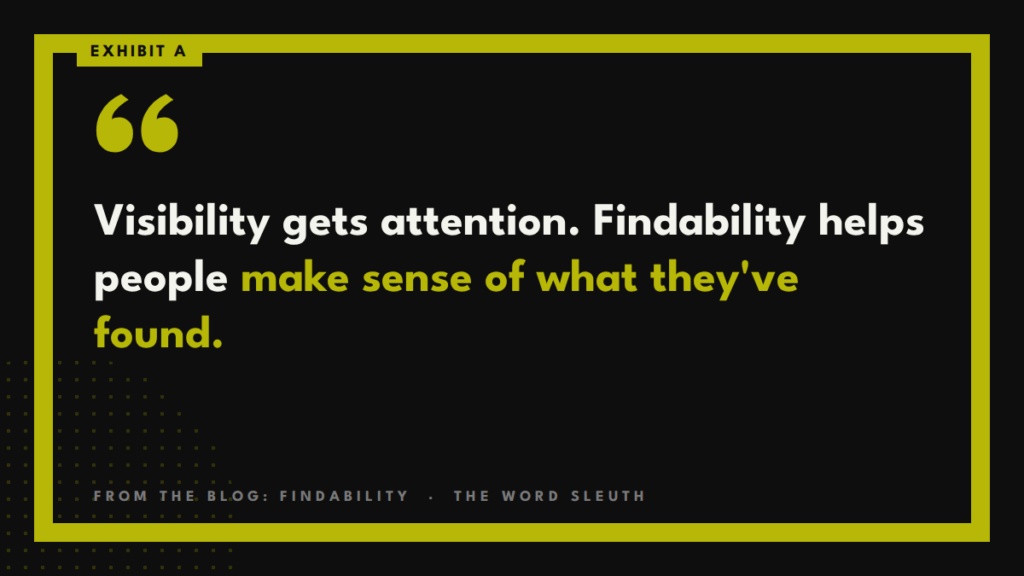
Visibility gets attention. Findability helps people make sense of what they’ve found.
A practice can post often, appear in a local magazine, and still be hard to choose. The posts are frequent but vague. The website lists services but says little about who the work is for. The Google Business Profile has few or no reviews and a number that goes to voicemail. Each of those moments costs trust at exactly the point someone was ready to act.
Findability connects exposure to meaning. When the right person comes across your name, they should quickly understand three things:
- what you help with,
- who you help, and
- why your approach deserves their confidence.
It matters for referrals too. When someone hears about you from a friend and looks you up, your digital footprint works like a first impression. It either confirms the trust the referral created or introduces doubt.
Visibility
asks, “Did people see us?” Findability asks, “Could the right people recognise
us, understand us and find credible evidence when they were ready?”
The Signals That Make a Practice Findable
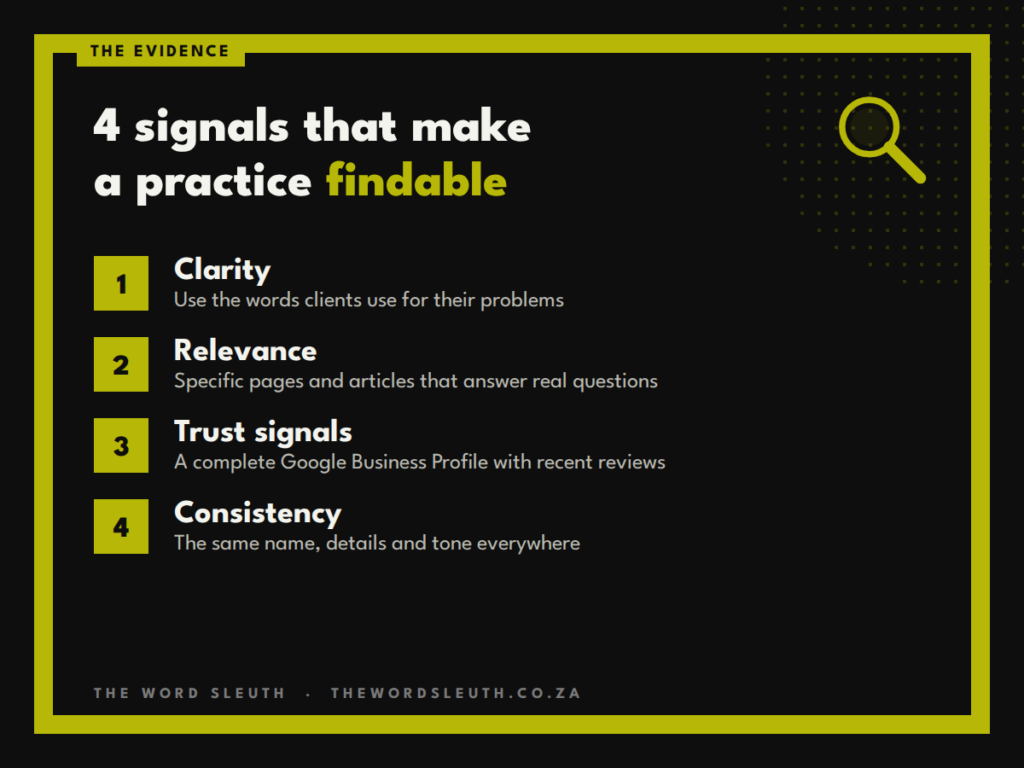
Findability comes from a set of connected signals rather than a single tactic. For businesses that rely on trust, four signals matter most.
Clarity. Be clear about what you do so your audience doesn’t have to decode it. Use the words clients use to describe their problems, then add your own point of view. Broad terms such as “holistic”, “client-focused” or “transformative” can hide the real value of your work, because everyone else uses them too. Be specific about who you help, how you help, and what makes your approach different. (We explore this in Clarity: The Strategic Advantage Behind Trustworthy Brands.)
Relevance. Search engines and people both look for a match between a question and an answer. Specific service pages, useful articles and a clearly defined audience send stronger signals than a stream of general advice. A counsellor who explains what a first session looks like is easier to find and easier to choose than one who describes “a safe space for growth”.
Trust signals. For local practices, the Google Business Profile is often the first place a prospective client evaluates you: services, location, hours, photos, reviews and how you respond to them. Being listed and being strategically findable are different things. A complete, accurate profile with recent reviews do quiet work every day, and it’s the foundation of local SEO. Qualifications, membership of professional bodies and clear information about fees add to it.
Consistency.
Your business name, contact details, terminology and tone should match across your website, Google profile, social accounts and directories. Consistency is how recognition builds over time, and mismatched details leave
both people and search engines less certain about you.
Connecting With People Where They Search
Search intent is the question beneath the search phrase. Someone typing “counsellor near me” or “financial adviser Johannesburg” is comparing options and ready to act. Someone searching “how to prepare for a retirement review” is still learning. Someone searching your name is checking what others say about you.
Your content should match the search intent:
- Near-me and local searches are answered mainly by your Google Business Profile and your service pages.
- Learning searches are answered by articles and guides that explain without pushing.
- Name searches are answered by reviews, your About page and evidence of your work.
Your website should be the central hub that connects everything. Social media platforms keep changing their rules and their reach, and an account can disappear overnight. A website, a Google Business Profile, and an email list are assets you control. Everything else, from a LinkedIn post to a podcast interview, works better when it leads people back to them.
You don’t need a content machine to make this work. One well-researched article can become a series of posts, a short video, an email or an answer to a question clients ask all the time. The goal is to meet people where they are with something genuinely useful, so discovery feels natural rather than pushy.
How to Know If Your Findability Is Improving
Not every useful signal shows up in a traffic report, so measure in layers.
Start with a search.
Google Business Profile Performance shows how many people found your profile, which searches they used, and how many called, asked for directions or clicked through to your website. Google Search Console shows which searches bring people to your site. Watch the ones that don’t include your name, because they show strangers finding you.
Then, look at behaviour.
Are visitors reading more than one page, joining your email list or
booking a first conversation? Are enquiries becoming a better fit, with fewer
people you can’t help?
When you get a
new client, ask how they found you and what made them reach out. Their answers
can reveal discovery paths your analytics miss, and the words they use make
great material for your next piece of content.
Review these
signals every quarter. Findability rarely arrives as one dramatic spike. More
often it shows up as a gradual shift: better-fit enquiries, fewer explanations
needed on first calls, and a growing sense that your practice is already
present when the right conversation begins.
Case Closed, for Now
Expertise alone doesn’t create demand if people can’t find, understand and trust it online. The encouraging part is that most of the evidence already exists: in your qualifications, your client outcomes, your reviews, and the way you explain your work. Findability makes that evidence easy to discover.
At The Word Sleuth, we begin by looking into what people see when they search for services like yours, then work to close the gap between the quality of your work and how it appears online.
Want to know what a stranger finds when they search for you?